Pipeline High Shear Emulsifier Pump
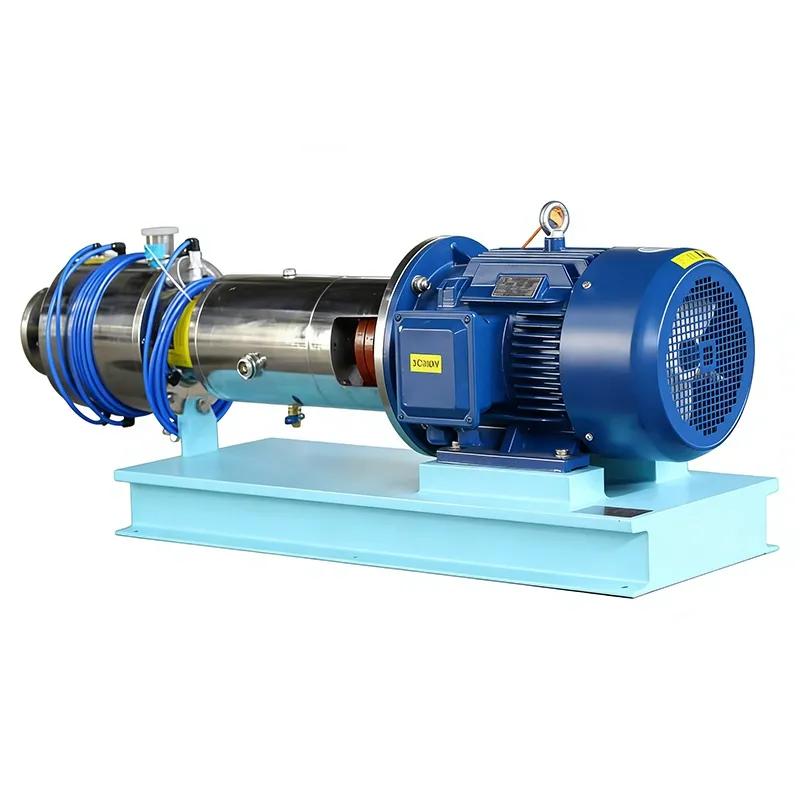
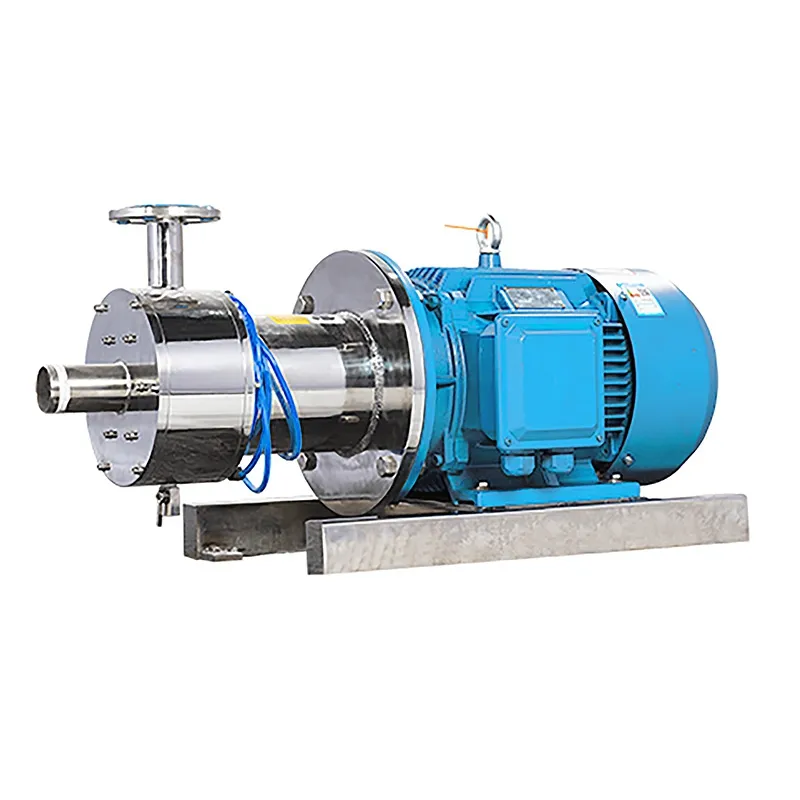
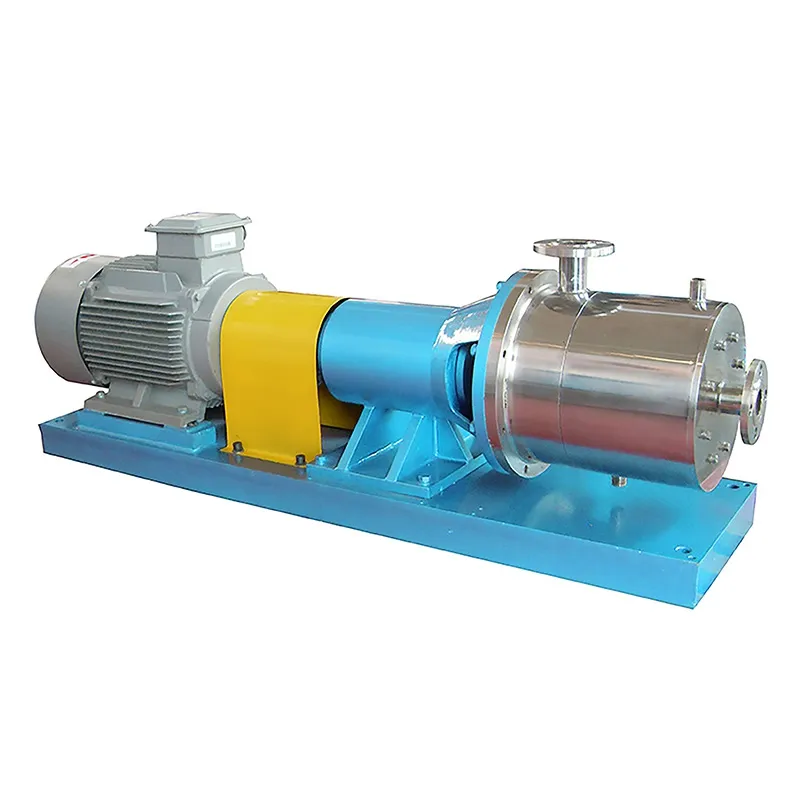
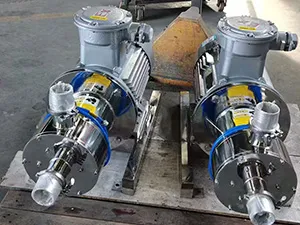
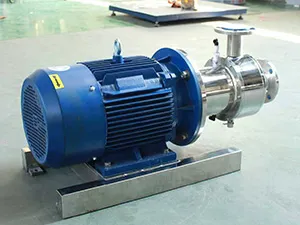
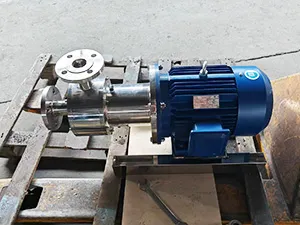
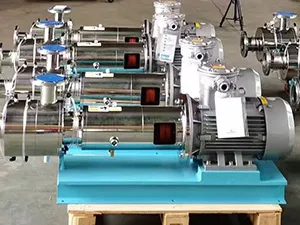
Pipeline high shear emulsifier pumps are installed in a pipeline or continuous production system to mix, disperse, homogenize, and emulsify materials as they pass through the working chamber. Inside the working chamber, the high-speed rotor and closely matched stator create strong shear, impact, turbulence, and centrifugal force. As the material passes through this area, droplets, soft agglomerates, or solid particles are broken down and distributed more evenly in liquid-liquid or liquid-solid formulations. The inline structure allows material to be processed continuously while also supporting transfer through the pipeline, which is suitable for large-scale production processes that require stable dispersion, emulsification, and more uniform material consistency.
| Model | Motor Power (kW) | Rotor Speed (rpm) | Flow Rate (m³/h) | Inlet Diameter | Outlet Diameter |
| 4 | 3000 | 2-14 | DN40 | DN32 | |
| 7.5 | 3000 | 8 | DN50 | DN50 | |
| 11 | 3000 | 12 | DN65 | DN50 | |
| 22 | 3000 | 22 | DN65 | DN80 | |
| 37 | 1500 | 30 | DN100 | DN100 | |
| 55 | 1500 | 40 | DN125 | DN100 |
Pipeline high shear emulsifier pumps are suitable for continuous mixing, dispersion, homogenization, and emulsification of chemicals, pharmaceuticals, food sauces, coatings, cosmetics, pesticides, emulsions, suspensions, and other inline formulations.
 Paints and Coatings
 Inks
Inks Leather Coatings
 Pesticides and Fertilizers
 Viscous Materials
 Cosmetics
 Chemicals
 New Materials
- Pipeline installation supports continuous inline processing, so materials can be mixed, dispersed, homogenized, or emulsified without relying only on batch tank operation. The emulsifier pump can be connected to automated production lines and larger-scale processing systems where steady material flow is required.
- The working chamber can be configured with single-stage or multi-stage rotor-stator structures, such as two-stage or three-stage designs. Each stage can also use different tooth layers, depending on the required shear strength, refinement level, and material characteristics.
- A rotor tip speed above 20 m/s can provide strong shear for droplet and particle size reduction, helping improve emulsion stability and reduce the risk of separation in products that require finer emulsification.
- The emulsifier pump can process low- to medium-high-viscosity materials, with suitable formulations reaching up to 20,000 cP. For materials with poor flowability, an inlet transfer pump can be used to feed the material more steadily into the working chamber.
- A double mechanical seal helps reduce leakage during inline operation. According to the process conditions, the sealing system can also be configured with independent cooling or a pressurized seal liquid tank for pressurized operation or temperature conditions from -20°C to 140°C.
- SS304 or SS316L stainless steel can be selected for the parts exposed to the material, depending on the required corrosion resistance and hygiene level. The rotor-stator head and inline chamber are easier to clean, and sanitary configurations can be customized for pharmaceutical, food, and cosmetics production.
- Modular Structure for Easier Maintenance
The modular structure allows easier disassembly, cleaning, inspection, and part replacement. Worn rotor-stator parts can be replaced more quickly without changing the full emulsifier pump. - Optional Temperature Control
A jacket can be added around the working chamber for cooling or heating media, helping control material temperature during inline emulsification, especially for heat-sensitive formulations. - Stable Operation with Lower Noise
An elastic coupling connects the motor and working head more smoothly, which helps reduce vibration and noise while supporting steadier operation and longer service life. - Non-Standard Customization Options
Materials such as titanium alloy, explosion-proof configurations, flange interfaces, and connection methods can be customized according to material properties, installation requirements, and special process conditions.